

The Importance of State Advocacy Overview
State advocacy is crucial to ensuring that responsible policies are in place to support the practice of medical genetics. The majority of legislation impacting healthcare is passed at the state level rather than the federal level. The involvement of medical genetics professionals in advocacy is key to helping state legislators understand medical genetics and the issues impacting patient care. Implementation of policies to advance medical genetics is dependent upon genetics professionals becoming leaders in shaping policy and advocating for patients.

How to Engage in State Advocacy
The first step to engaging in state advocacy is familiarizing yourself with your state’s legislature. Start by finding your state legislature’s website. The Congress.gov federal directory of state legislatures provides links to official state legislative websites for all fifty states as well as federal districts and territories. From your state legislature’s website, you will be able to find your specific elected officials. Most state legislatures have two chambers (e.g., assembly and senate) similar to the U.S. Congress, which means most constituents will have an assembly representative and a senate representative. Elected officials’ webpages vary in resources, but almost all display means to contact their office as well as biographies, committee assignments, press releases, and more. We encourage you to sign up for your member’s newsletters to keep up to date with their issues of concern, voting record, virtual town halls, and other in-person or virtual events.
Why Should I Be a State Advocate?
State legislatures develop policies that impact many different aspects of healthcare. Examples of issues that are often handled at the state level include licensure, newborn screening, privacy, Medicaid, coverage of specific services, scope of practice, and reproductive healthcare. States also get more done — the federal government is slow to pass new legislation, whereas many state legislatures enact new legislation at a much faster pace. State legislators are also more responsive; it is often easier to meet with state legislators because they are local and have smaller constituencies.

State Advocacy Versus Federal Government
Just like the federal government, each individual state legislative website includes methods to find and contact your elected officials, as well as search for state legislation. Unlike the federal government, not all states meet yearly, and many states have shorter sessions than the federal government. The timing of when states are in session and will be passing new laws varies. For example, California has a full-time legislature that meets for nine months of every year. Texas has a part-time legislature that only meets for six months every other year. Florida’s legislature meets every year but only for 60 days.
Requesting a Meeting
To request a meeting with your state representative, you can send an email or use the contact forms listed on their webpage. Make sure to identify yourself as a constituent, state your profession and connection to the topic, and include the reason for the meeting request. Below is an example of a meeting request to a state representative:
Dear Assemblyperson / Representative / Senator ___,
My name is _____, and I am a medical geneticist and your constituent. I am writing to request a (virtual/in-person) meeting to discuss _______ and its significance to healthcare. My availability is as follows: __________. Please let me know a time that is convenient for you and/or your staff.
Thank you for your time, and I look forward to meeting with you to discuss ______.
Sincerely,
(Name, Physical Address, Contact Information)
Be sure to follow up on your email after a week if you haven’t heard back from the office.
What to Expect
Some offices may accept in-person meetings, whereas others may prefer virtual. In either case, there is a rare chance you will meet with your representative directly. Most likely, you will meet with a health staffer from the office. These staffers handle their office’s healthcare portfolio and will brief the representative on issues raised by constituents. Do not be disappointed if you don’t meet directly with your state representative; staffers are critically important gatekeepers of information and are often more aware of in-depth issues within their respective portfolio.

Preparing for a Meeting
Understand who you are talking to
- Once you receive confirmation that a meeting has been scheduled, ask if you will be talking to the representative or their staff. Most often, you will meet with a staffer.
- Each state is different, and during a non-legislative session the legislator might have one staffer that works with multiple offices.
- A state like California has a year-round legislature and will have staff available in both the state capitol and in a district office.
Know your issue
You should aim to explain the core issue in under 3 minutes. Most staff cover a variety of issues, so keeping your explanation of an issue brief and as simple as possible will make it easier for them to understand and remember. Most are also not trained in genetics, but many are interested to learn. Be sure to stay on topic. Overall, you should plan for a 15-minute meeting, so it is recommended that you prepare ahead of time by identifying the key points you want to cover. It may be helpful to research the representative ahead of time so that you are aware of the issues they care about, their voting record, and so on. This can help you frame the issue in a way that they will be receptive to.
Have a specific ask
When meeting with a legislative office, you should always have a clear “ask.” This could be something such as:
- Will you support or oppose a specific bill?
- Would you be willing to develop legislation to address this issue?
- Can you speak on this issue during an upcoming hearing? (This would only be appropriate if the representative is on the committee that is going to be holding the hearing.)
- Representatives and their staff receive a lot of requests from constituents — be prepared to explain why your ask is important in the universe of all asks made to the office.

Sending a Letter
You can also send a letter to your state representative to explain an issue without requesting a meeting. Your state representative’s webpage will most likely list their mailing address as well as a webform for electronic submission of your letter.
Other important things to keep in mind when writing a letter:
- Why is this letter or opinion piece warranted?
- Conciseness is key.
- Make it personal.
- Minimize technical language.
- Tie your comments back to local needs and issues.
- Always abide by any word count limits if submitting through a webform.
- Make sure to include your contact information.
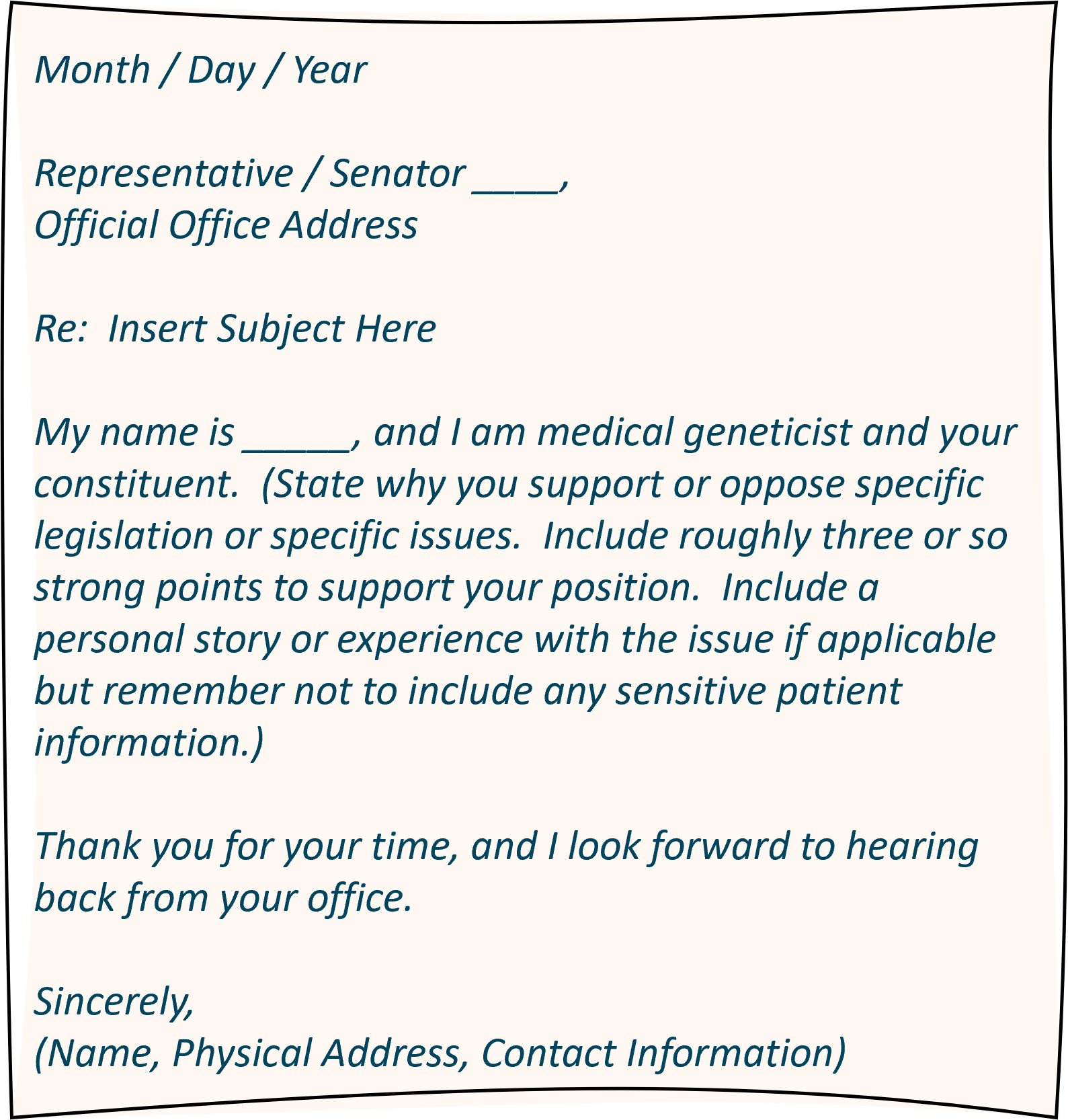
Below is an example of how you might format your letter.
Social Media
Most state representatives have at least one social media page (e.g., X/Twitter, Facebook). Following members’ social media accounts can help you stay informed about the everyday issues that an elected official is focused on. Social media handles are usually listed on the representative’s official government website but can also be found through searches on respective social media websites or through internet search engines. Public-facing social media accounts often do not respond to messages, so attempting to schedule a meeting via social media is not recommended. However, tagging the representative in a post not only ensures that their office sees the information, but it also raises awareness for other constituents who are also on social media.